

Protecting Living Heritage from “Development”: Egypt Must Halt Actions Undermining St Catherine’s Monastery and Rights of Monks
Press Release
The Egyptian Initiative for Personal Rights (EIPR) renewed its call for the Egyptian government to cease all measures and pressures that threaten the heritage and cultural identity of Saint Catherine’s Monastery and its surroundings in South Sinai. This demand follows renewed concerns from UNESCO regarding threats to the integrity and authenticity of this World Heritage site, fueled by state efforts to "develop" the area into a commercial tourism hub.
During its annual session last July, the UNESCO Intergovernmental Committee for the Protection of the World Cultural and Natural Heritage—tasked with monitoring the World Heritage Convention—adopted by consensus a resolution urging the Egyptian government to suspend the "Great Revelation – Land of Peace" project (GRLP), pending a thorough technical assessment of the project’s impact on the Outstanding Universal Value (OUV) of the Saint Catherine region.
This resolution, adopted for the third time, was informed by a report from the International Council on Monuments and Sites (ICOMOS), an expert body dedicated to conserving tangible cultural heritage. The report warned that “with its already constructed components, the ‘Great Revelation Initiative–the Land of Peace project’ could cause significant permanent negative impacts to the integrity and authenticity of the property.”
The UNESCO committee also recommended a reactive monitoring mission to evaluate potential mitigation measures. It underscored that preserving Saint Catherine’s OUVrequires protecting not only the monastery and its archaeological structures but also the entire surrounding natural landscape.
According to the committee’s report, the Egyptian government informed UNESCO that a presidential “directive” was issued in September 2025 to halt the GRLP project until UNESCO’s Heritage Impact Assessment (HIA) requirements are fulfilled. However, no official statement regarding this suspension has been released in Egypt, nor has the autonomous Greek Orthodox Archdiocese of Sinai, which oversees the monastery, been notified.
Furthermore, statements by the head of the Sinai Development Authority last June confirmed that approximately 97.5% of the project was complete. This was accompanied by an official update from the Ministry of Housing, Utilities, and Urban Communities last May indicating that the project is in its final stages. These developments suggest that permanent impacts on the heritage site have already occurred, casting doubt on the efficacy of any alleged "presidential directives."
EIPR is deeply concerned by testimonies indicating that Egyptian authorities continue to pressure the monastery’s leadership and monks into signing an agreement that would formalize the state's expropriation of the monastery and its lands. This proposed agreement would restrict the monks’ rights to a mere "right to utilize" limited to sites deemed strictly "religious" in character, threatening the monastery’s environment and way of life that has been preserved for over 1,400 years.
Sources close to the monastery report that the government has refused to recognize the current abbot, elected by the Assembly of Fathers in October 2025, by withholding the customary presidential decree of appointment. Instead, ratification has been made conditional upon the monastery signing the aforementioned agreement. Under these terms, the abbot would only be granted "religious possession," and his legal residency would be limited to a renewable three-year permit, without the customary grant of Egyptian citizenship provided to his predecessors.
EIPR fears these pressures are an attempt to preempt a final ruling by the Court of Cassation regarding the land ownership dispute. On May 28, 2025, the Ismailia Court of Appeal granted the abbot "religious possession" over 29 sites but denied legal ownership. While the court rejected a government lawsuit to evict monks from 17 plots held under preliminary sales contracts, it ordered their eviction from lands deemed to lack a "religious character," mandating their transfer to the South Sinai Governorate. Both parties have appealed this ruling.
The government’s handling of the monastery’s property rights is inextricably linked to the ongoing "development" schemes in Saint Catherine. These works have introduced drastic changes under the GRLP project, launched in November 2021 to market the area as an international destination for spiritual tourism.
Notably, the Egyptian government previously recognized the ownership rights of the Archbishop of Sinai over the monastery “and its outlying chapels, gardens, paths, and all other structures” in the official nomination file it submitted to UNESCO when Saint Catherine was inscribed on the World Heritage List at the turn of the millennium.
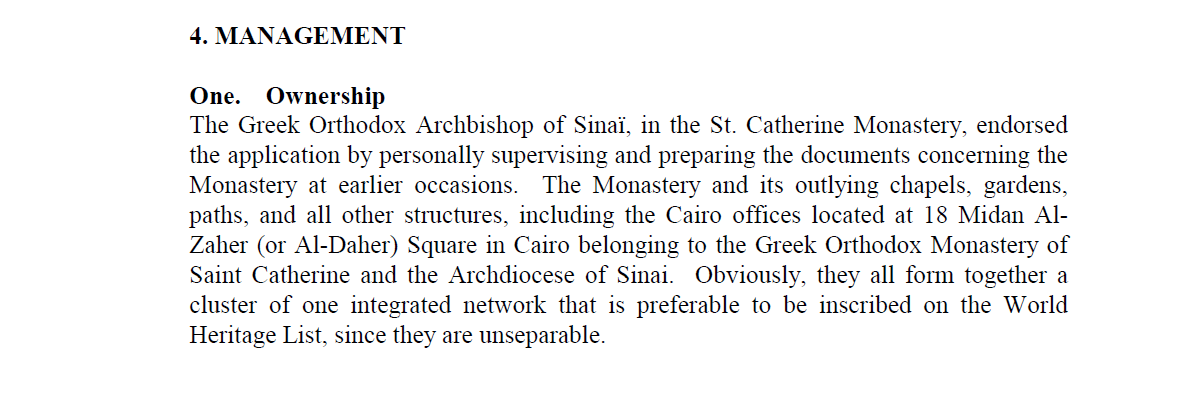
Official Egyptian nomination file submitted to UNESCO for Saint Catherine’s Monastery, p.38.
EIPR maintains that the government's actions to alter ownership and possession violate Egypt's obligations under the International Covenant on Economic, Social and Cultural Rights (ICESCR)—specifically the principle of "non-retrogression." Taking deliberate steps to diminish existing cultural rights constitutes a violation of Article 2(1) of the Covenant, which Egypt ratified in 1982.
The government is obligated to reach an agreement that preserves the monastery as a living religious heritage site and guarantees the monks’ rights over their surrounding environment—an essential space where they conduct their lives as an integral part of the heritage site itself.
Historically, monastic life in Saint Catherine has contributed to developing the area by establishing a self-sufficient infrastructure. Monasticism in Saint Catherine was never confined to prayer and devotion alone; it encompassed land reclamation, well-digging, and centuries of peaceful coexistence and cooperation with local Bedouin tribes to sustain life in Saint Catherine.
This history was fundamental in shaping the unique character of Saint Catherine, at the heart of which lies the monastery and its monastic life. Unlike many uninhabited historic sites, Saint Catherine remains a living heritage site. This distinctiveness requires a legal framework for ownership that respects and protects the unique status and continuity of the monks of Saint Catherine.
For more information:


