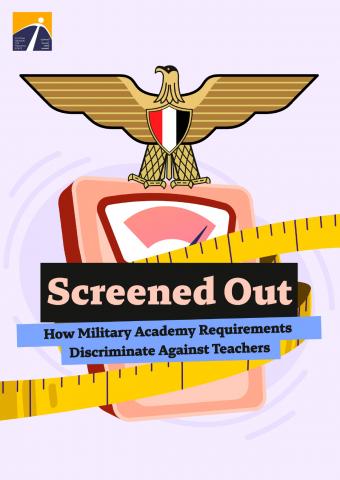
Screened Out.. How Military Academy Requirements Discriminate Against Teachers

Read the full report here
“I applied, my papers were accepted, and I was given an exam date in December at the Central Agency for Organization and Administration. I traveled, took the exam, and thank God, when the results came out, I had passed. Then our names were announced in the directorates, and we were given a date for pedagogical training. They told us we would start work in the second term.
Then, a month and a half later, we were sent to another training, this time physical training. A circular was issued saying that anyone appointed to the state had to take a six-month training course at the Military Academy. Because of our large numbers, they said we would go through tests, but that they would be routine and everything would be fine. They kept telling us this even at the Military Academy.
Then we went to collect the file from the Military Academy, were given a date for the medical examination, and later received the message for the physical fitness test. We prepared the file, the original documents, and civil registry papers such as the family record. On the physical fitness test day, I had to do 35 push-ups in one minute, 35 sit-ups in one minute, and run 100 meters in 15 seconds. Of course, these were extremely exhausting exercises, and we had not been trained for them. On top of that, we had to travel overnight and then stand in the sun until they organized us, while we had no idea why any of this was happening or what relevance it had to our work as teachers.
Then I never received a message for the panel interview, and no reason was given. Whenever we asked, they would say the system was down and that messages would be sent later. In the end, we found out that they had not allowed overweight candidates to attend the panel interview. Of course, many of our colleagues said, ‘Why don’t you just lose weight? How did you let yourself get to that weight?’ Then a journalist went on television and said the same thing. So now we are treated as outcasts, as if weight were a disability that makes someone unfit to work.”
Introduction
The Minister of Education and Technical Education announced in late October 2024 that the teacher shortage had reached around 665,000 teachers, a deficit affecting the education system as a whole. To bridge this gap, the state announced a competition to appoint 150,000 teachers over five years. But the process did not run smoothly. In the first round of the competition, held to appoint 30,000 teachers, candidates passed all the tests set by the Ministry of Education and administered by the Central Agency for Organization and Administration. Yet new “training” requirements were later announced at the Military Academy, including physical fitness tests and a panel interview, known as the “kashf hay’a.” This led to the exclusion of thousands of successful candidates on the grounds of physical unfitness, pregnancy, or failure to pass the final panel interview.
Several problems marred the competition, including the fact that the Military Academy tests were not announced at the start of the process. More importantly, however, they are unconstitutional and unlawful, particularly because the tests are based on discriminatory criteria related to the physical appearance of teachers. This violates the constitution, which prohibits discrimination and guarantees equality, in addition to breaching Egyptian laws and international human rights conventions.
In light of this, the teachers have waged an ongoing battle against this injustice and discrimination, turning to the executive and legislative authorities, as well as the courts. Many of them demonstrated in the New Administrative Capital outside the Ministry of Education on 15 October 2023. Security forces arrested 14 of them and referred them for interrogation before the Supreme State Security Prosecution, which ordered their detention until they were all released in February 2024.
The Egyptian Initiative for Personal Rights later turned, together with several teachers, to the Administrative State Council Court. EIPR filed appeals on behalf of 106 excluded candidates, including 94 women and 12 men. In the appeals, EIPR detailed the violations involved in the Military Academy training programs, which led to the exclusion of 11,951 teachers, and demanded that they be annulled on the grounds that they had no relevance to the educational process.
During the first-instance litigation, the State Commissioners Body issued a report in favor of the teachers, recommending their appointment at the ministry. However, the court did not adopt the authority’s opinion and rejected all lawsuits in November 2024. In its reasoning, the court merely stated that “contracts may not be concluded except after passing the training programs determined by the Minister of Education and Technical Education, and in accordance with the attached contract template and no other,” without addressing the constitutional concerns surrounding the Military Academy training programs, the exclusion of pregnant women, recent mothers, and those suffering from obesity, or responding to those concerns.
EIPR appealed the ruling, but the Supreme Administrative Court also rejected all the lawsuits, relying on the same grounds adopted by the court of first instance.
In addition to the constitutional and legal concerns surrounding the Military Academy training programs, detailed in this report, including the exclusion of teachers because of their weight, the state ignores Egypt’s obesity figures. According to 2022 data from the World Obesity Federation, obesity rates in Egypt stood at 55.8% among women and 24.8% among men.
The matter did not stop at litigation. Several members of parliament submitted briefing requests to former education minister Reda Hegazy, but he only indicated that the ministry would give those who had failed the Military Academy tests another chance, without addressing the unconstitutionality of these tests or their relevance to the educational process in the first place.
In May 2025, EIPR also sent a letter to Engineer Hatem Nabil, head of the Central Agency for Organization and Administration, following his appointment. The letter explained the dimensions of the problem with the Military Academy tests and urged him to ensure justice for the teachers. As of the publication of this report, however, EIPR had not received any response.
With their discriminatory conditions, these tests stood in the way of an effective, necessary, and urgent solution to the teacher shortage crisis, which state officials have repeatedly acknowledged. Over decades of underfunding and the absence of effective interventions to address crises, Egypt’s education crisis has grown more complex and intertwined. Underfunding has produced numerous problems, most notably a shortage of schools and the poor quality of education, pushing families to resort to private tutoring to compensate for the absence of education in schools. Egyptian household spending on private tutoring reached 28.3% of total education spending, according to the latest statistics published by the Central Agency for Public Mobilization and Statistics in 2020. Underfunding has also had a severe impact on teacher numbers and on the ratio of teachers to students, even though teachers are the backbone of the educational process.
This report arrives at several key conclusions:
-
The Military Academy tests do not merely violate the article prohibiting discrimination in the Egyptian constitution, which is serious in itself. They go further, violating the broader body of citizenship rights, whose importance the constitutional legislator recognized by affirming their various principles across several articles that complement one another. Nor did the legislator stop at setting out rights guarantees, such as equality, non-discrimination, equal opportunity, and citizens’ right to hold public office on the basis of merit and without favoritism. It also required state institutions to work toward realizing these rights, meaning that they must take positive steps to put them into effect, not undermine them, especially since they are fundamental rights inherent to the person, inalienable, and may not be violated by the state.
-
The various state institutions — executive, legislative, and judicial — failed to do justice to the excluded candidates who were victims of multidimensional discrimination. Instead, they played a role in entrenching these violations, either by attempting to give them a legal veneer or by deliberately ignoring citizens’ appeals and requests for a review of these measures. The issuance of these court rulings against them also reflects the weakness of the infrastructure supporting equality and non-discrimination in Egypt, despite the existence of constitutional provisions requiring the state to establish and support such infrastructure.
-
These discriminatory and unnecessary tests waste public funds by allowing large numbers of candidates to sit the Central Agency for Organization and Administration tests, only for them to be excluded after successfully passing those tests for reasons that are unlikely to change during the testing process, such as pregnancy, disability, or being overweight, even though they possess all the skills required by the nature of the job.
-
These tests entrenched the “militarization of jobs” and encroached on the mandates and roles of other government bodies and institutions. The Military Academy thus came to hold decisive power over whether appointments were made, even when all the required conditions had been met, and without any mechanism for reviewing its decisions, even internally. For example, this process encroaches on the role of the medical boards affiliated with the Ministry of Health, the body responsible for conducting pre-employment medical examinations according to public, clear, and proportionate standards suited to the nature of the workplace and the job performed. By contrast, the academy conducted medical tests without disclosing the rules it had set for passing them.


